Game Localization
Localization of menus and dialogues from English to Japanese and Dutch, preserving cultural nuances for a natural gaming experience.
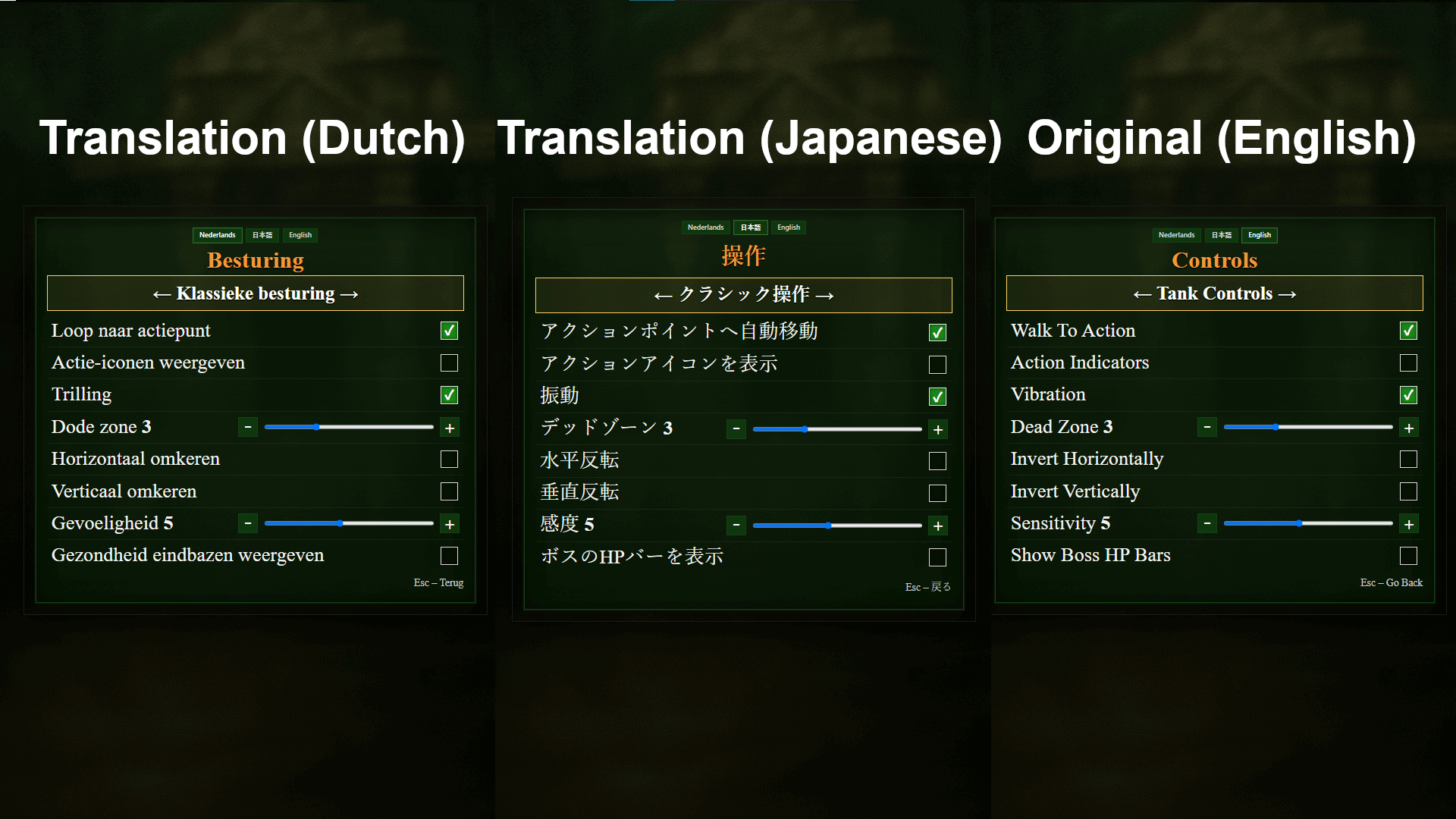
Challenge: "Translation is correct, but the message isn't"
Game localization is more than just translation.
- A direct translation loses a character's personality.
- Ignoring UI constraints (character counts, line breaks) breaks the layout.
- If cultural nuances don't come across, players can't empathize.
The result: a translation that is 'correct' but doesn't 'work'.
Solution: "Adjusting the experience"
Dialogues are not direct translations but retain the character's voice. UI texts are made short and consistent.
- Preserving character: Not translating literally, but adapting to natural spoken language within that culture.
- Respecting UI limits: Taking into account character limits, line breaks, and menu structures.
- Consistent terminology: Keeping terms uniform throughout the game to avoid confusion.
- Rhythm check: Reading texts aloud to remove unnatural sentence constructions.
Technical details
- Creating terminology list: Defining game-specific terms, character names, and items.
- Context analysis: Playing the game to fully understand the context of the translation.
- Platform-specific conventions: Ensuring terminology aligns with the gaming culture in Japan and the Netherlands.
Result: "Smooth and flawless text"
- Menus and dialogues that feel natural and don't break the layout.
- Positive feedback from players about the 'natural translation'.
- Met all UI constraints, resulting in zero correction requests from the development team.
The language barrier has been removed, allowing players to fully immerse themselves in the game's world.